
🔐 Why the AAA Framework Matters in Cybersecurity
Every secure digital system — from enterprise networks and cloud platforms to banking apps and corporate VPNs — depends on three critical security principles: Authentication, Authorization, and Accounting (AAA).
Without AAA, organizations cannot properly verify identities, control access, or track user activity. This creates severe cybersecurity risks including unauthorized access, insider threats, credential abuse, ransomware infections, and compliance failures.
The AAA framework is one of the foundational pillars of modern cybersecurity architecture and is used across:
- Enterprise networks
- Cloud computing platforms
- Identity and Access Management (IAM)
- VPN infrastructure
- Zero Trust security models
- Remote workforce systems
- Wi-Fi authentication systems
- Data centers and critical infrastructure
📚 Table of Contents
- What Is the AAA Framework?
- Authentication Explained
- Authorization Explained
- Accounting Explained
- How AAA Works Together
- AAA Protocols and Technologies
- Real-World AAA Examples
- Cyberattacks Against AAA Systems
- AAA Security Best Practices
- AAA and Zero Trust Security
- AAA in Cloud Computing
- Authentication vs Authorization vs Accounting
- FAQ
- Final Summary
- References
🔐 What Is the AAA Framework?
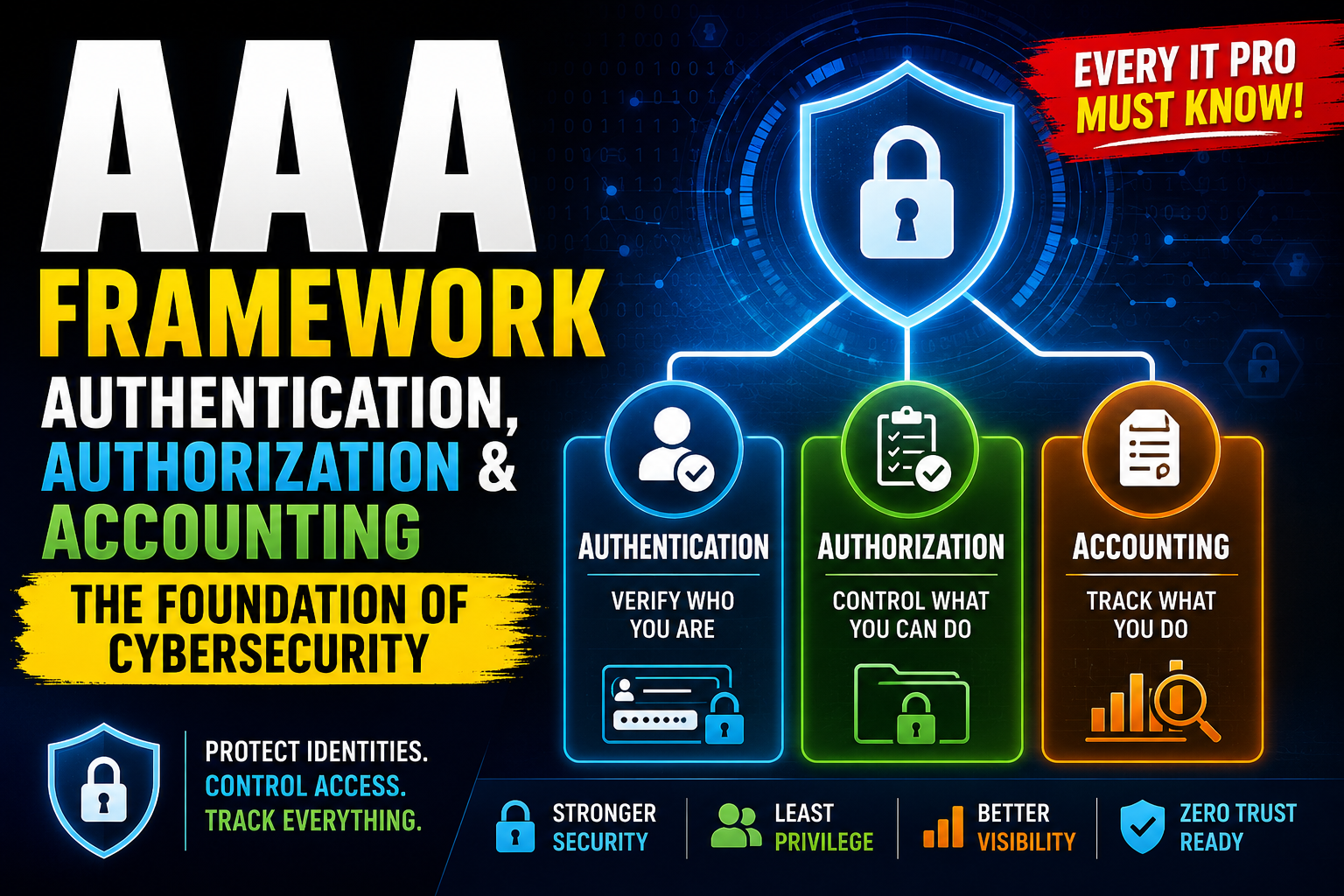
AAA stands for:
- Authentication → Verifying identity
- Authorization → Determining permissions
- Accounting → Tracking and logging activities
Together, these three components create a complete access control and monitoring system for digital environments.
💡 Simple Analogy
Authentication: “Who are you?”
Authorization: “What are you allowed to do?”
Accounting: “What did you actually do?”
Why Organizations Depend on AAA
AAA helps organizations:
- Prevent unauthorized access
- Enforce security policies
- Protect sensitive data
- Monitor suspicious behavior
- Meet compliance requirements
- Support incident investigations
- Reduce insider threats
- Enable Zero Trust architectures
⚠️ Critical Security Insight
Many major cybersecurity breaches occur because organizations implement weak authentication, excessive permissions, or insufficient logging.
AAA directly addresses all three problems.
🛡️ Authentication Explained
Authentication is the process of verifying that a user, device, or system is genuinely who they claim to be.
Common Authentication Methods
| Authentication Type | Example | Security Level |
|---|---|---|
| Password-Based | Username + password | Low to Medium |
| Multi-Factor Authentication (MFA) | Password + phone code | High |
| Biometric Authentication | Fingerprint or face scan | High |
| Certificate-Based | Digital certificates | Very High |
| Token-Based | Hardware security key | Very High |
The Three Authentication Factors
- Something you know → Password, PIN
- Something you have → Phone, smart card, security key
- Something you are → Biometrics
✅ Best Practice
Modern cybersecurity standards strongly recommend Multi-Factor Authentication (MFA) for all sensitive systems.
MFA can stop the majority of credential-based cyberattacks.
Real-World Authentication Example
When you log into online banking:
- You enter your username and password
- The bank sends a verification code to your phone
- The system validates your identity
- You are granted access
This is a practical example of authentication in action.
🔑 Authorization Explained
Authorization determines what an authenticated user is allowed to access or perform.
Even after identity verification, users should only receive the minimum access necessary.
Authorization Examples
| User Role | Access Permissions |
|---|---|
| HR Employee | Employee records only |
| Database Administrator | Full database management |
| Guest User | Limited read-only access |
| Finance Manager | Financial systems access |
Common Authorization Models
1. Role-Based Access Control (RBAC)
Permissions are assigned based on job roles.
Example:
- Managers → approval privileges
- Developers → code repository access
- Support staff → ticketing system access
2. Attribute-Based Access Control (ABAC)
Access decisions are based on:
- User attributes
- Location
- Time of access
- Device security posture
3. Least Privilege Access
Users receive only the permissions absolutely necessary to perform their duties.
🚨 Common Security Failure
Excessive permissions are one of the biggest causes of insider threats and ransomware spread.
Attackers frequently exploit overprivileged accounts to move laterally across networks.
📊 Accounting Explained
Accounting refers to recording, monitoring, and auditing user activities within systems and networks.
It provides visibility into:
- Who accessed systems
- When access occurred
- What actions were performed
- Which resources were used
- Whether suspicious behavior occurred
Examples of Accounting Data
- Login timestamps
- Failed login attempts
- File access records
- VPN session logs
- Network bandwidth usage
- Administrative changes
- Security policy modifications
Why Accounting Is Critical
Accounting helps organizations:
- Investigate cyber incidents
- Detect insider threats
- Identify suspicious behavior
- Meet compliance requirements
- Support digital forensics
- Monitor employee activity
- Improve operational security
🔍 Security Insight
Without proper logging and accounting, organizations often discover breaches months after attackers initially gained access.
⚙️ How AAA Works Together
Typical AAA Workflow
- User attempts login
- Authentication verifies identity
- Authorization checks permissions
- User gains approved access
- Accounting logs all activities
Enterprise Example
An employee connects remotely to a company VPN:
- Authentication verifies username, password, and MFA
- Authorization grants access only to approved applications
- Accounting records session duration, IP address, and activity logs
🌐 AAA Protocols and Technologies
1. RADIUS
Remote Authentication Dial-In User Service (RADIUS) is widely used for:
- Wi-Fi authentication
- VPN access
- Network access control
- Enterprise remote access
2. TACACS+
Terminal Access Controller Access-Control System Plus (TACACS+) is commonly used in:
- Network device administration
- Cisco infrastructure
- Privileged access management
3. LDAP
Lightweight Directory Access Protocol (LDAP) helps manage centralized identity systems.
4. Kerberos
Kerberos uses ticket-based authentication to securely verify users across networks.
5. SAML and OAuth
Modern cloud platforms commonly use:
- SAML for enterprise Single Sign-On (SSO)
- OAuth for delegated application access
🏢 Real-World AAA Examples
Corporate Wi-Fi Security
- Authentication → Employee credentials
- Authorization → Access based on department
- Accounting → Device connection logs
Cloud Computing Platforms
Cloud providers such as :contentReference[oaicite:0]{index=0}, :contentReference[oaicite:1]{index=1}, and :contentReference[oaicite:2]{index=2} use advanced AAA systems for:
- Identity management
- Role-based permissions
- Audit logging
- API security
- Zero Trust enforcement
Healthcare Systems
Hospitals use AAA to:
- Protect patient records
- Restrict medical data access
- Log access attempts
- Meet HIPAA compliance requirements
🚨 Cyberattacks Against AAA Systems
1. Credential Stuffing
Attackers use stolen passwords from previous breaches to access accounts.
Defense Strategies
- MFA enforcement
- Passwordless authentication
- Login rate limiting
- Behavioral analytics
2. Privilege Escalation
Attackers exploit authorization weaknesses to gain higher-level access.
Common Techniques
- Misconfigured permissions
- Token theft
- Kernel exploits
- Service account abuse
3. Log Tampering
Cybercriminals attempt to erase accounting logs to hide malicious activities.
Mitigation
- Immutable logging
- Centralized SIEM systems
- Real-time monitoring
- Secure backups
⚠️ Attack Reality
Many ransomware groups specifically target identity systems such as Active Directory because compromising AAA infrastructure gives attackers widespread access.
✅ AAA Security Best Practices
🔐 AAA Security Checklist
- Enable MFA everywhere possible
- Use strong password policies
- Implement least privilege access
- Review permissions regularly
- Centralize identity management
- Monitor suspicious login activity
- Deploy SIEM solutions
- Secure administrative accounts
- Use passwordless authentication where possible
- Maintain detailed audit logs
- Encrypt authentication traffic
- Segment privileged accounts
Modern AAA Enhancements
- Adaptive authentication
- Behavioral biometrics
- Risk-based access control
- Passwordless identity systems
- AI-powered anomaly detection
🛡️ AAA and Zero Trust Security
Modern cybersecurity increasingly relies on the Zero Trust model.
Zero Trust assumes:
- No user should be automatically trusted
- Every access request must be verified
- Continuous authentication is required
- Access should be tightly restricted
How AAA Supports Zero Trust
| AAA Component | Zero Trust Role |
|---|---|
| Authentication | Continuously verifies identity |
| Authorization | Restricts access dynamically |
| Accounting | Monitors all activity |
☁️ AAA in Cloud Computing
Cloud environments depend heavily on AAA systems because users access resources remotely from various devices and locations.
Cloud AAA Challenges
- Identity sprawl
- Shadow IT
- API abuse
- Misconfigured permissions
- Cross-cloud complexity
- Third-party integrations
Cloud AAA Best Practices
- Implement Identity and Access Management (IAM)
- Use conditional access policies
- Monitor API usage
- Restrict administrative privileges
- Enable centralized logging
- Use federated identity systems
📋 Authentication vs Authorization vs Accounting
| Component | Primary Purpose | Example |
|---|---|---|
| Authentication | Verify identity | Password + MFA |
| Authorization | Control permissions | Access control lists |
| Accounting | Track activities | Audit logs |
📈 Cybersecurity Facts About Identity Attacks
📊 Important Statistics
- Most modern cyberattacks involve compromised credentials
- Phishing remains a leading cause of authentication compromise
- Weak authorization policies contribute heavily to lateral movement attacks
- Organizations without centralized logging often detect breaches far later
- MFA significantly reduces account takeover risk
❓ Frequently Asked Questions (FAQ)
What is the purpose of the AAA framework?
The AAA framework helps organizations verify identities, control user permissions, and monitor system activity to improve cybersecurity and operational visibility.
What is the difference between authentication and authorization?
Authentication verifies identity, while authorization determines what the authenticated user is allowed to access or perform.
Why is accounting important in cybersecurity?
Accounting provides audit logs and monitoring data that help detect attacks, investigate incidents, and meet compliance requirements.
What protocols support AAA?
Common AAA protocols include:
- RADIUS
- TACACS+
- LDAP
- Kerberos
- SAML
- OAuth
How does MFA improve authentication security?
MFA requires multiple verification factors, making it significantly harder for attackers to compromise accounts using stolen passwords alone.
Can AAA help prevent ransomware attacks?
Yes. Strong authentication, least privilege authorization, and comprehensive logging help reduce ransomware spread and improve detection capabilities.
🧠 Final Summary
🔑 Key Takeaways
- AAA stands for Authentication, Authorization, and Accounting
- Authentication verifies identity
- Authorization controls permissions
- Accounting tracks user activity
- AAA is foundational to cybersecurity architecture
- MFA and least privilege are essential best practices
- AAA supports Zero Trust security models
- Strong logging and monitoring improve threat detection
- Modern cloud environments heavily depend on AAA systems
As cyber threats continue evolving, organizations must strengthen identity security and access management more than ever before.
The AAA framework remains one of the most important cybersecurity concepts every IT professional, business owner, and security practitioner should understand deeply.
📚 References & Trusted Cybersecurity Sources
- [NIST Cybersecurity Framework](https://www.nist.gov/cyberframework?utm_source=chatgpt.com)
- [CISA Identity and Access Management Guidance](https://www.cisa.gov?utm_source=chatgpt.com)
- [OWASP Authentication Cheat Sheet](https://owasp.org/www-project-cheat-sheets/cheatsheets/Authentication_Cheat_Sheet.html?utm_source=chatgpt.com)
- [Microsoft Security Documentation](https://learn.microsoft.com/en-us/security/?utm_source=chatgpt.com)
- [Google Cloud Identity Documentation](https://cloud.google.com/identity?utm_source=chatgpt.com)
- [NIST Digital Identity Guidelines](https://pages.nist.gov/800-63-3/?utm_source=chatgpt.com)