
📌 Quick Definition
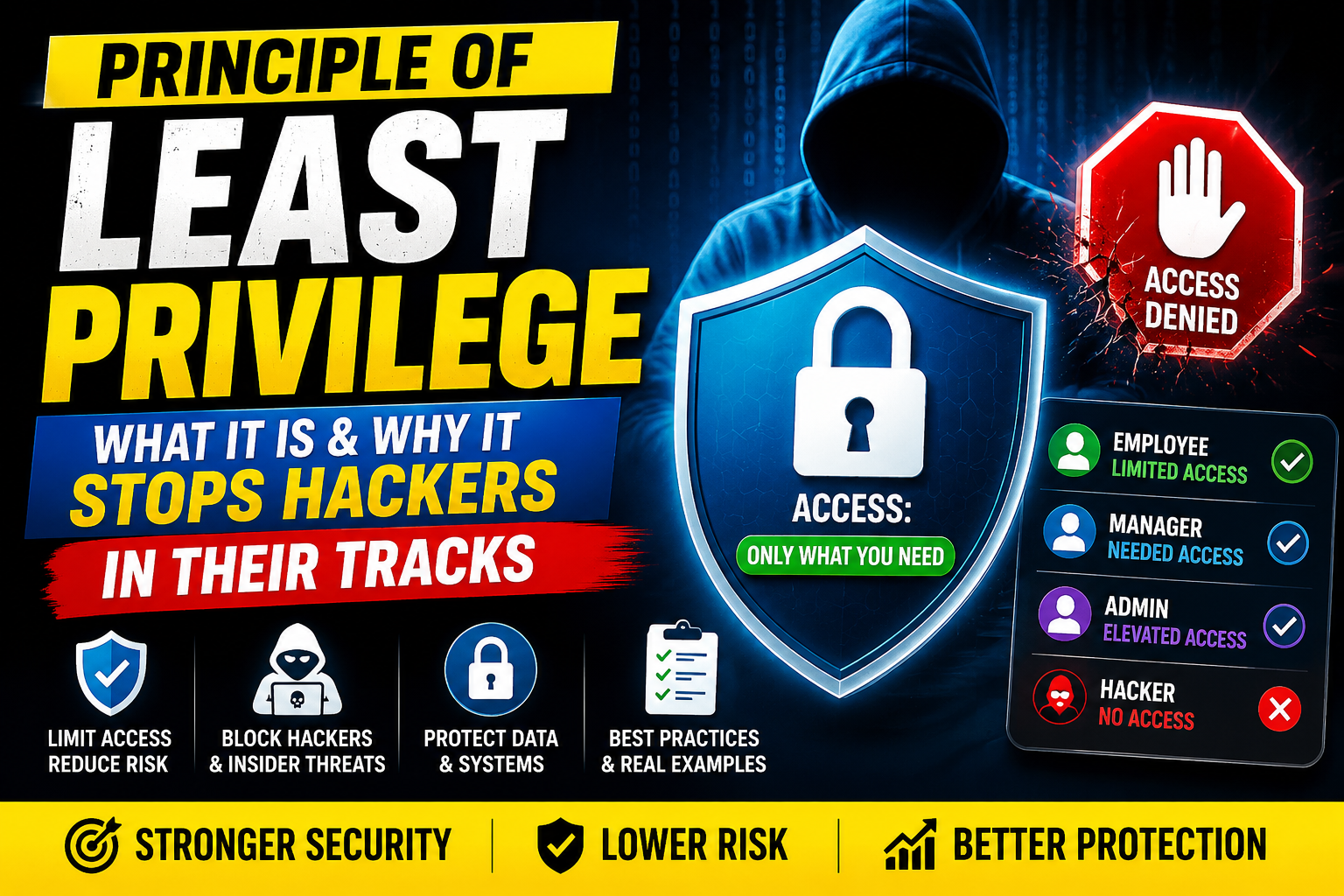
The Principle of Least Privilege (PoLP) is a cybersecurity concept that gives users, systems, applications, and devices only the minimum access and permissions they need to perform their tasks — nothing more.
By restricting unnecessary access, organizations drastically reduce the damage attackers can cause if an account or system becomes compromised.
📚 Table of Contents
- What Is the Principle of Least Privilege?
- Why Least Privilege Matters in Modern Cybersecurity
- How Hackers Exploit Excessive Permissions
- Real-World Examples of Least Privilege
- Key Benefits of PoLP
- Risks of Ignoring Least Privilege
- How to Implement Least Privilege
- Advanced PoLP Security Practices
- Least Privilege in Cloud Security
- PoLP and Zero Trust Security
- Common Mistakes Organizations Make
- Tools That Help Enforce PoLP
- Comparison Table
- Frequently Asked Questions
- Summary
- References
🔐 What Is the Principle of Least Privilege?
The Principle of Least Privilege (PoLP) is a foundational cybersecurity and access control concept stating that:
Users and systems should only receive the minimum level of access required to complete their legitimate tasks.
This principle applies to:
- Employees
- Administrators
- Applications
- Servers
- Cloud workloads
- Databases
- Third-party vendors
- IoT devices
- APIs and service accounts
For example:
- A receptionist should not have access to payroll systems
- A marketing employee should not be able to modify firewall settings
- A customer support agent should not have database administrator privileges
- A mobile app should not have access to device files it doesn’t need
⚠️ Why This Matters
Every unnecessary permission becomes a potential attack path for hackers.
🌍 Why Least Privilege Matters in Modern Cybersecurity
Modern cyberattacks rarely begin with sophisticated hacking techniques. In many cases, attackers simply:
- Steal legitimate credentials
- Compromise a low-level account
- Move laterally through the network
- Escalate privileges
- Gain administrative control
When users or systems have excessive privileges, attackers can rapidly:
- Deploy ransomware
- Steal sensitive data
- Disable security systems
- Create hidden administrator accounts
- Access cloud infrastructure
- Exfiltrate customer records
💡 Key Insight
Least privilege doesn’t necessarily stop attackers from gaining initial access — it limits how far they can go afterward.
🧨 How Hackers Exploit Excessive Permissions
1. Credential Theft
Attackers commonly steal credentials through:
- Phishing emails
- Malware
- Credential stuffing
- Password spraying
- Social engineering
If the compromised account has broad access, the attacker immediately inherits those permissions.
2. Privilege Escalation
Hackers often search for:
- Misconfigured permissions
- Shared administrator accounts
- Unpatched vulnerabilities
- Weak Active Directory settings
- Excessive cloud IAM roles
3. Lateral Movement
Once inside a network, attackers move between systems looking for:
- File shares
- Backup servers
- Domain controllers
- Financial systems
- Cloud management consoles
🚨 Attack Scenario
A help desk employee receives a phishing email and unknowingly enters credentials into a fake login page.
The attacker logs in using the stolen account.
If the employee has excessive permissions:
- The attacker may access HR systems
- Download customer databases
- Create administrator accounts
- Disable antivirus tools
- Deploy ransomware organization-wide
With proper least privilege controls, the attacker’s access would be heavily restricted.
🏢 Real-World Examples of Least Privilege
Example 1: Banking Systems
Bank tellers can process transactions but usually cannot:
- Modify backend financial databases
- Approve large wire transfers alone
- Access executive financial systems
Example 2: Hospital Networks
Nurses may access patient records relevant to their department but not:
- Full hospital infrastructure
- Billing systems
- Server administration tools
Example 3: Cloud Environments
Developers may deploy applications but not:
- Delete production databases
- Modify identity policies
- Disable security logging
✅ Key Benefits of the Principle of Least Privilege
| Benefit | Explanation |
|---|---|
| Reduced Attack Surface | Limits what attackers can access after compromise |
| Containment of Malware | Prevents ransomware from spreading easily |
| Protection Against Insider Threats | Employees cannot access unnecessary sensitive data |
| Improved Compliance | Supports regulations like HIPAA, PCI DSS, and GDPR |
| Reduced Human Error | Minimizes accidental deletion or misconfiguration |
| Better Visibility | Makes suspicious activity easier to detect |
⚠️ Risks of Ignoring Least Privilege
1. Massive Data Breaches
Overprivileged accounts are frequently involved in major breaches.
2. Ransomware Catastrophes
If ransomware gains administrator rights, it can:
- Encrypt backups
- Disable security tools
- Spread across the entire network
3. Insider Abuse
Disgruntled employees may steal:
- Customer databases
- Trade secrets
- Financial information
- Intellectual property
4. Cloud Misconfigurations
Excessive cloud permissions are among the most common causes of modern cloud breaches.
📊 Cybersecurity Fact
Many major breaches involve compromised accounts with excessive privileges rather than advanced hacking tools.
🛠️ How to Implement Least Privilege
Step 1: Inventory Accounts and Permissions
Identify:
- User accounts
- Administrator accounts
- Service accounts
- API keys
- Cloud IAM roles
- Third-party access
Step 2: Apply Role-Based Access Control (RBAC)
RBAC assigns permissions based on job roles instead of individual users.
Example roles:
- HR Staff
- Sales Team
- IT Administrators
- Finance Department
Step 3: Remove Unnecessary Privileges
Review permissions regularly and revoke:
- Unused accounts
- Old contractor access
- Temporary permissions
- Legacy administrator rights
Step 4: Implement Just-In-Time (JIT) Access
Provide administrative access only when needed and for limited time periods.
Step 5: Monitor Privileged Activity
Track:
- Login events
- Permission changes
- Administrative actions
- Suspicious behavior
✅ Least Privilege Checklist
- Remove shared admin accounts
- Enable multi-factor authentication (MFA)
- Use separate admin and standard accounts
- Review permissions quarterly
- Disable inactive accounts
- Segment sensitive systems
- Log privileged actions
- Use password managers
🚀 Advanced Least Privilege Security Practices
1. Privileged Access Management (PAM)
PAM solutions secure highly privileged accounts through:
- Password vaulting
- Session monitoring
- Credential rotation
- Approval workflows
2. Micro-Segmentation
Divides networks into isolated zones to restrict lateral movement.
3. Zero Standing Privileges
No user permanently holds administrator access.
4. Conditional Access Policies
Access decisions may depend on:
- Location
- Device security
- User behavior
- Risk score
5. Application Whitelisting
Only approved applications can execute.
☁️ Least Privilege in Cloud Security
Cloud environments introduce unique permission challenges.
Common Cloud Risks
- Overly permissive IAM roles
- Public storage buckets
- Excessive API permissions
- Unused access keys
- Cross-account trust misconfigurations
Cloud Platforms That Rely Heavily on PoLP
- Amazon Web Services (AWS)
- Microsoft Azure
- Google Cloud Platform (GCP)
🔐 Cloud Security Tip
Always start with “deny all” permissions and explicitly grant only required access.
🛡️ PoLP and Zero Trust Security
The Principle of Least Privilege is a core component of the Zero Trust security model.
Zero Trust Philosophy
Never trust. Always verify.
Zero Trust assumes:
- No user is automatically trusted
- No device is automatically safe
- Every request must be validated
How PoLP Supports Zero Trust
| Zero Trust Principle | How PoLP Helps |
|---|---|
| Limit blast radius | Restricts attacker movement |
| Continuous verification | Reduces permanent access |
| Assume breach | Contains compromised accounts |
❌ Common Least Privilege Mistakes
1. Giving Everyone Administrator Rights
This is one of the most dangerous practices in cybersecurity.
2. Forgotten Accounts
Inactive employees and contractors often retain access for months or years.
3. Shared Credentials
Shared admin accounts eliminate accountability.
4. “Temporary” Access That Becomes Permanent
Emergency privileges are frequently never removed.
5. Ignoring Service Accounts
Machine accounts often have excessive privileges and weak monitoring.
🧰 Tools That Help Enforce Least Privilege
| Category | Purpose |
|---|---|
| Identity & Access Management (IAM) | Controls user permissions |
| Privileged Access Management (PAM) | Secures admin accounts |
| Multi-Factor Authentication (MFA) | Adds identity verification |
| Endpoint Detection & Response (EDR) | Detects suspicious activity |
| Security Information and Event Management (SIEM) | Centralizes monitoring and logging |
📊 Least Privilege vs Excessive Privileges
| Security Area | Least Privilege | Excessive Privileges |
|---|---|---|
| Attack Surface | Small | Large |
| Ransomware Impact | Limited | Catastrophic |
| Insider Threat Risk | Reduced | High |
| Compliance Readiness | Strong | Weak |
| Visibility & Auditing | Clear | Difficult |
🧠 Key Takeaways
🔐 Core Principle
Give only the minimum permissions necessary.
🛡️ Security Advantage
Limits attacker movement after compromise.
☁️ Modern Relevance
Critical for cloud, Zero Trust, and ransomware defense.
⚠️ Biggest Risk
Excessive privileges are a major cause of data breaches.
❓ Frequently Asked Questions (FAQ)
What is the Principle of Least Privilege in simple terms?
It means giving users and systems only the access they absolutely need to do their jobs — nothing extra.
Why is least privilege important?
It reduces cyberattack damage, limits insider threats, improves compliance, and prevents attackers from gaining widespread control.
How does least privilege stop ransomware?
Ransomware can only access files and systems available to the compromised account. Restricted permissions limit its spread.
What is the difference between least privilege and Zero Trust?
Least privilege focuses on minimizing permissions, while Zero Trust is a broader security model based on continuous verification and assuming breach.
Does least privilege apply to cloud environments?
Yes. It is especially important in cloud security because cloud permissions are often highly granular and easily misconfigured.
What are privileged accounts?
Accounts with elevated permissions such as administrators, root users, or cloud IAM roles with advanced capabilities.
Can small businesses implement least privilege?
Absolutely. Even basic measures like removing administrator rights, enabling MFA, and reviewing user access can significantly improve security.
📌 Summary
The Principle of Least Privilege is one of the most effective cybersecurity strategies for reducing risk, containing attacks, and protecting sensitive systems.
In today’s threat landscape — where ransomware, credential theft, cloud attacks, and insider threats are increasingly common — excessive permissions can quickly turn a minor incident into a devastating breach.
Organizations that implement strong least privilege practices gain:
- Better security
- Reduced attack surfaces
- Improved compliance
- Greater operational control
- Stronger resilience against modern cyber threats
Whether you are a home user, small business owner, IT professional, or aspiring cybersecurity expert, understanding and applying least privilege is essential in the modern digital world.
📖 References & Trusted Cybersecurity Sources
- NIST (National Institute of Standards and Technology) — Access Control & Zero Trust Guidelines
- CISA (Cybersecurity and Infrastructure Security Agency) — Identity and Access Management Best Practices
- OWASP — Principle of Least Privilege Security Guidance
- Microsoft Security — Privileged Access Security Strategies
- Google Cloud Security — IAM and Least Privilege Recommendations
- AWS Security Best Practices — IAM Least Privilege Policies